 This month’s chat focused on how the lessons from Donald H Graves’ ‘Writing: Teachers and Children at Work’ are reflected in and influence our classroom practice. HUGE thanks to everyone who contributed this month: @navangovender1 @jotregenza @MrsSmanwar @one_to_read @waynebarberuk @BaaBaaGee @lynseyhunter @sirmobbsalot @mcollino @imaginecentre @SadiePhillips @echedge @AP_Literacy @son1bun @MrsHgrps @MrMJLane
@lynseyhunter @simonegoward @jonnybid @WinterImagines @mr_o_connor @RhayPrimaryHead @SouthdaleSchool @lalmighty2012 @MrsM_Y6 @missteachR
If you would like to read the Donald H Graves chat in its entirety on Twitter or focus on one particular area of the discussion, you can access each section by clicking on the hyperlinked question numbers in the subheadings below. Otherwise, here’s a summary of our discussion:
Q1) How do I find out if children’s writing skills are taking hold?
- My class are very into ‘free writing’ where they write for themselves. I love to see how their own excitement in writing this way, not instigated by a teacher, results in writing that shows authentically where they are as writers.
- Also, the way in which they structure their writing process – do they plan? Do they edit? Are they aware of the importance of these, again, authentically speaking.
- I was thinking about this today in relation to the new Ofsted framework. I think you know when children’s skills are developing when they:
- become knowledgeable about the different reasons in which we are ‘moved’ to write.
- become increasingly knowledgeable about the variety of ways in which they can reach and leave an impression on a variety of audiences through writing.
- become increasingly knowledgeable of the writing processes and over time, come to develop their own preferred writing process
- become increasingly knowledgeable about how grammar works within the craft of writing
- become increasingly knowledgeable about how to ensure their punctuation use and other conventions aids their audience’s ability to read their writing easily and how they intended
- become increasingly knowledgeable about proof-reading their writing effectively and so correct unsure spellings before a piece of writing goes to publication.
- become more knowledgeable about the legibility of handwriting and its importance in relation to future readers.
- I believe this is happening when you see children re-reading their writing aloud and listening to how their words sound.
- I think you know the skills are taking hold when kids are excited by what they write, can share it and are happy to take feedback to make it better – in this culture of writing, they know their words, style, perspectives are valued.
- I also think they learn over time, how to work within and contribute to a community of writers.
- The class wanted to make a class newspaper. Their idea, brought up in our class meeting. I see these ‘inspired’ moments as developing them hugely and in this case, seeing that writing is not only done individually but as a community, as you say.
- Allowing children to have a session where they can write freely away from success criteria and other constraints.
- When you have that moment in the classroom to say to a child that they can “just write” and they fist pump the air!
- Ooh and by continuously getting children to look back and celebrate what they have done and how they have got better.Reply
- By giving them a range of opportunities to write in a range of styles for a range of purposes.
- We use #freewritefriday a great way to let children demonstrate their writing skills outside the constraints of the curriculum
- An increased awareness of audience shown through emphasis on greater clarity of writing.
Q2) How can I help the class to work better on their own?
- Early results from @lit4pleasure’s research are showing that children are able to write well on their own when they have agency over two things: their writing processes and the subject of their writing. Being able to undertake writing conferences with their peers also helps.
- Have you made any video to share with the community? Would love to see.
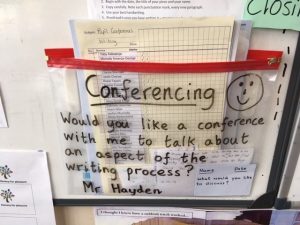
- No videos as of yet. Our dear friend Murray Gadd is about to release around 50 videos showcasing aspects of writing workshop. We do have this really neat photograph of a teacher’s classroom which utterly encourages self-regulation:
- I get the children to make some of the decisions on how they want to learn, they can choose their own learning style to practise skills
- For example I have children who love to talk their ideas through so I have a non-verbal cue which allows them to just get on and do it without asking!
- Others love to use flip chart paper and use colours to make their ideas really visual…
- Some just want to go straight into writing their ideas and get out their spell checkers and dictionaries…
- Knowing your writers/ class really well by using teacher /child conferencing. When you know where there are, you can support them wherever they are in their writing journey. Scaffold and slowly take it away when the child has become more confident.
- I love this question! It’s quite a complex answer though! Basically, I don’t enjoy modelling writing; I prefer to work from where the children are and develop accordingly. This way a huge amount of independence develops. I try to help the class see that their writing matters. More than what ‘I’ think is better. I help them to see I can show them ways to shape and phrase their ideas in writing but that comes from knowing them as writers and what they want to say. Again, independence and self-confidence emerge.
Q3) How do I approach writing assessment?
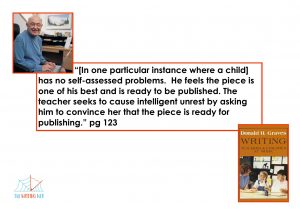
- Writing assessment is so difficult and has become so unnecessarily complicated over the years. Any form or ‘formal’ assessment I’ve seen is a tick boxing ritual that forces writers into pigeon holes and creates ‘forced’ writing.
- I don’t think you can assess it on your own. I liked the idea of ‘box ticking’ as an NQT because I needed guidance but over time I’ve realised that this shifts the focus and made me look specifically for semi-colons etc. rather than simply asking “Is this writing good? Did it suit the audience/purpose?” I like the language that the CLPE scales uses, the focus on next steps, the fact there’s no age / year group mentioned and that there’s next steps for each stage of writer.
- Consider the purpose and audience…. did it hit the mark?
- Department Of Education Australia’s ‘Writing Map Of Development’ is an unbelievable resource for helping you assess writing.
- Here is the Canadian version.
- I think that much of the tension around assessing writing exists when we focus on summative assessment. Regular formative assessment through dialogue promotes and supports children’s writing; the most important aspect of the assessment process is creativity itself.
- I absolutely agree that the best results come from children enjoying writing and being supported to use grammar and punctuation to aid the reader’s understanding and engagement- not with a view to shoehorning in any they haven’t used.
- Regular opportunity for writing. Daily if possible. Watch out for what they’re doing in their writing. Make sure they enjoy what they’re writing about and it’s relevant. Bad assessment of writing comes from ‘false’ writing that is not always authentically inspired.
- Absolutely, the best writing comes from what they want to write about.
- Conferencing also helps to assess their understanding of how / why authors use particular techniques. They might be able to justify their choices etc.
- Thanks! I’m really wary of assessment that is narrow. Skills are skills and they can be evidenced in thousands of different kinds of writing. Children can get disheartened about writing development if not given the opportunity to enjoy what they are writing about.
- We purchased the HfL Writing Teacher Assessment Frameworks. We use them for moderation and to a lesser extent to inform teaching and learning.
- Personally think assessment of writing is one of the hardest things to do. It’s subjective. There are so many different elements to consider. Assessing comparatively helps but also in collaboration with other teachers and schools (if possible) is important for increased
- It can be so subjective which always casts doubt on accuracy. I love the idea of collaboration – this might ease the stress!
- When it comes to judging WA or GD: wet finger in the air and see which way the wind is blowing?
- To me, as a profession, we have massively over-complicated assessment (lots of reasons why, obvs!) Notice what children can do, identify what they need to do next, plan to meet those needs, model the skill, provide purpose and hook ‘em in. Repeat!
- I think not always being hung up on assessing everyone on the exact same thing. Free writing gives an opportunity to explore different ideas perhaps we should collect assessment evidence with a similar open mind.
- Some children need to cling tightly to what the teacher has been modelling and to be given a tighter task. For others this can make their writing sound unnatural and stilted. This is not to say I wouldn’t collect a range of types of writing. Sometimes we need to be open to allowing children to shine in their own way. Other times we can guide them to avoid being stuck in a genre rut.
Q4) How do I find time to publish children’s writing?
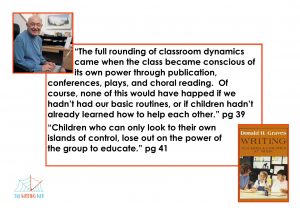
- Could be as simple as actually posting a letter they’ve written or spending a lesson combining poetry and art or, like many have said, simply publishing for the class book corner. I look out for projects where a book can also be the final product. I often block out an afternoon!
- Poetry Post! We love writing poems for the local community and then delivering them round the village. Gives the children a genuine audience and we get some wonderfully positive responses on social media.
- Did a similar thing but with a poet-tree. Put it in the playground this week at pickup time for all to enjoy.
- The children LOVE this part! If the children are really into it (sometimes they beg to publish) and want to spend time on it, I put aside an afternoon, mostly a Friday
- Setting up class publishing houses is a great way for children to publish.
- I would love to see a return to children making real books every term, they were such lovely things for the library
- Let’s make it happen!
- With younger children create a compilation of pieces from across the class, so they can enjoy each other’s work. My class have loved making a class riddle and joke book, sold to parents to cover colour printing costs.
- Some of my children love to publish comics and they ask to stay in at break and lunch time to do it. Of course I let them!
- Easiest would be to photocopy their work and staple together to form publication. Or I’ve had a few children who will produce comics which can go straight into classroom library.
- Could be stapled for the book corner – will be read over and over again! Writing needs true purpose and audience (publish OR perform!) to be authentic and engaging. They take such pride in the finished product. The end goal shouldn’t just be for the teacher to read / mark.
- This is tough but it needs to be built in. It’s so important for motivation. I’m thinking that as I develop the children’s abilities in making books / laying out newspaper pages etc. they will start to be able to do it themselves and need me less.
- Motivation is key here and if they feel empowered they will want to keep writing and publishing.
- We place a huge emphasis on our displays as an opportunity to publish work. Children also take home their published work to their parents at the end of each writing cycle. It’s the most important part! In addition we use twitter loads for giving children an audience.
- We love to see your published outcomes!
- I am going to start my 5 and 6 year olds recording their stories and then setting them up on a listening post.
- I wonder if they could be put on Soundcloud?
- The children love blogging, where their writing can be read and commented on by wider audiences.
- If they’re loving what they’re writing it gets photocopied and sent home. Y1-6 created their own story books recently that they are obsessed with (no exaggeration there). We’re now looking at building on this enthusiasm for publishing their own work.
- Sadly, this can be the part that often gets overlooked. We have just planned three lessons into next week for various publishing, which we are excited about! We will be creating our own picture books, complete with cover and blurb and creating a digital video version using the iPads!
- This enables the children to work on a variety of skills including Speaking and listening. They are then able to take their books home to share with family and some will also have copies in the school library. Developing a purpose and love for writing is essential.
If you are interested in learning more about how Donald H Graves’ research can inform your classroom practice there’s loads to choose from. You can view his extensive catalogue of work, along with an obituary, on his publisher’s website, here.
You can view the entire 2019 #WritingRocks schedule here. Thank you everyone who shared insightful research findings, resources, challenges and nuggets of wisdom gleaned from their own practice. As always, massive thanks to Phil and Ross at @lit4pleasure for their invaluable support and encouragement before, during and after the event.
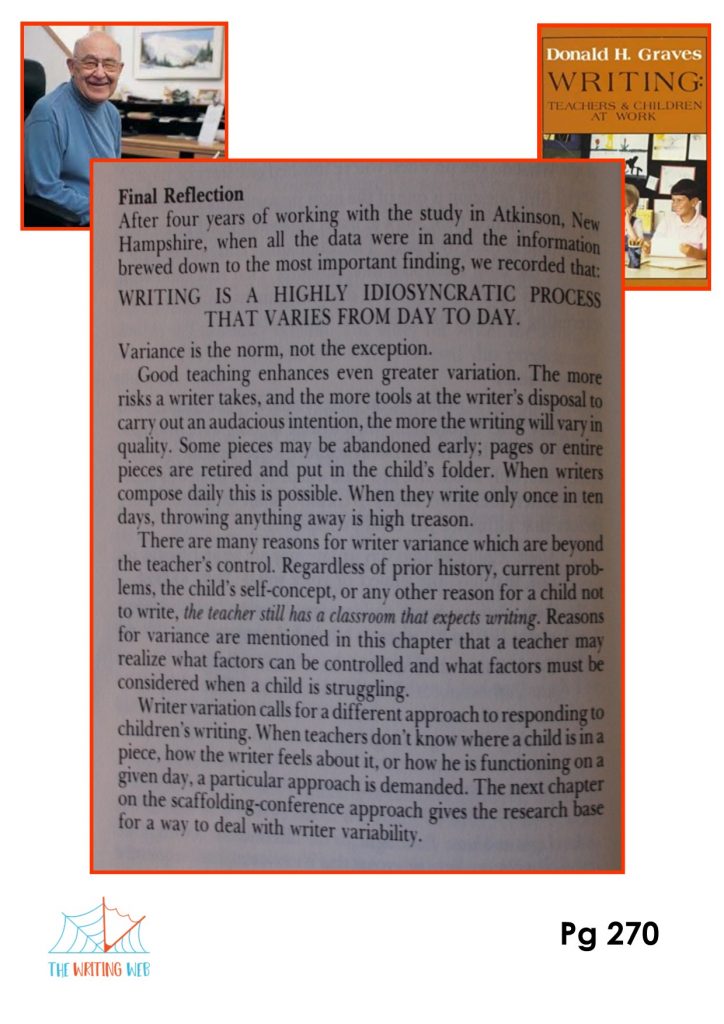
Our next #WritingRocks chat will be at 8pm [GMT] on Wednesday 26th June when we’ll be drawing together our thoughts on how the insights from Carolyn Steedman’s ‘The Tidy House: Little Girls Writing’ (1983) might inform our classroom practice.
In the run up to the next chat, we’ll be posting questions in advance and would love you get involved.
Nicola