Special exhibition at the British Library until 27th August 2019.
 I was immersed for almost two hours this exhibition, following the journey of writing from hieroglyphs to emojis, when I visited earlier this Summer with my mum. We were lucky to find ourselves following two calligraphy experts around the earlier sections; eavesdropping on their observations was certainly a bonus. Even without the benefit of these additional insights, I’d highly recommend you (re)visit this celebration of writing in its final week.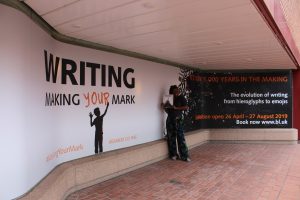
If you can’t make it to the exhibition and have a spare half hour, British Library curators – Adrian Edwards, Peter Toth, Emma Harrison and Michael Erdman – have created a FacebookLive talk which you can access here. (You do not need to have a Facebook account to watch the video of their insightful tour of the gallery.) The same team have also produced a series of videos sharing the stories behind some of their favourite items featured in the exhibition. The British Library have a wealth of associated online resources, including several digitised manuscripts.
 Here are the points I chose to transfer to my notebook:
- The invention of writing 5,000 years ago revolutionised society. People were now able to communicate across time and space:
- * Keeping accounts / counting things
- * Marking possessions / naming things
- * Communicating from beyond the grave
Mum identified the last of these as something she’d like to start looking into. 😲
- Even within a single system, the popularity of different writing styles comes and goes.
- The development of different styles of letters (of the alphabet) results from a desire to balance clarity with speed of writing, while reflecting the purpose of the text and the artistic tastes of the period.
- Way back in the 2nd century, a child practising their writing dutifully copied these words in their homework book:
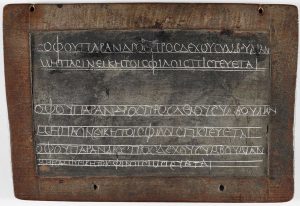
2,000-year-old homework book, student copies his teacher’s Greek script.
These wax diptycha or writing tablets were sufficiently fascinating to refocus mum’s goals on something grounded more firmly in this world, leading her to announce: “I’m going to learn to scratch in wax.”
- It looked as though Alfred Lord Tennyson’s damaged quill pen had been retrieved from the bin by an enterprising servant. I hope they received a financial reward in their lifetime.
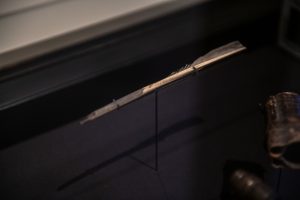
Dip into a brief history of writing materials and technologies here.
- The modern pencil developed in the 16th century, following the discovery in Cumbria of pure block graphite.
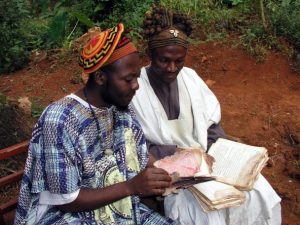
Idrissou Njoya and Nji Mapon examine Mapon’s endangered manuscript collecti
- Bamum is an indigenous African script that fell out of use in 1931 but has seen a revival in usage since 2007. Why? Find out more about a very important project here. The outcome will be saving for future generations the most significant pre-industrial and non-western holding of indigenous script manuscripts in all of sub-Saharan Africa. 🙌🏾
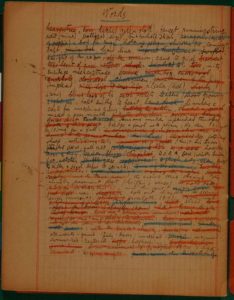 I loved seeing James Joyce’s innovative style of notetaking; his collection of notes for the novel Ulysses is personal and unique. Each point has been colour-coded red or blue, according to their destination in various parts of the work. I often use colour when note-taking, especially when I’m mind mapping.
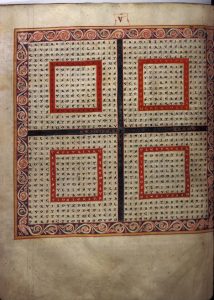
- Rabanus Maurus’s 12th century manuscript Figural Poems highlights the playful possibilities of writing. It features a Latin poem with an equal number of letters in each line, written continuously and laid out in a grid.
- eL Seed is a street artist who communicates his messages, which relate to their context and have a universal dimension, in Arabic script. He says: “Art is a pretext for amazing human experience. My art is ephemeral by essence. It means it will eventually disappear. But what remains is memories of people I’ve met along the journey.”

eL Seed’s Sprawling Mural Pays Homage to Cairo’s Garbage Collectors.
This made me reflect from a different perspective on a recent conversation I had with Ross Young from Literacy for Pleasure about the nature of publishing in 2019, in light of the editable nature of blogs etc. It chimes with my love of the writing process itself and collaborations involved.
- Writing has the power to elevate as well as educate. For the Vai people of West Africa, the creation of their own syllabic writing system in the 1830s was a means of creating equality with the European colonists who controlled their land. 🙌🏾
All in all, it’s a beautiful thing to put pen to paper.
As is spending an afternoon with your mum.
🧡
If you’d like a more lively, witty review of the Writing: Making Your Mark exhibition, check out Lauren Collins’s efforts in The New Yorker or the Histories of the Unexpected podcast.
I’d love it if you would share your thoughts on this review below.
Thank you. 🧡