
The first #WritingRocks chat of 2020 featured faces (old and new) reflecting honestly on how the messages in Margaret Meek’s ‘On Being Literate’ are reflected in and might inform our classroom practice. BIG thanks for your contributions: @lit4pleasure @one_to_read @therroneill @Miff__ @gurevitchesque @MrWellbeing1 @alastair_daniel @LHteaching @Toriaclaire,@Citygoldfinch @Marcelavb3 @BethRowe1 @jonnybid @missk_primary @MrsSmanwar @MissOakley_ @kashleyenglish @larrainesharri3 @TobiasHayden
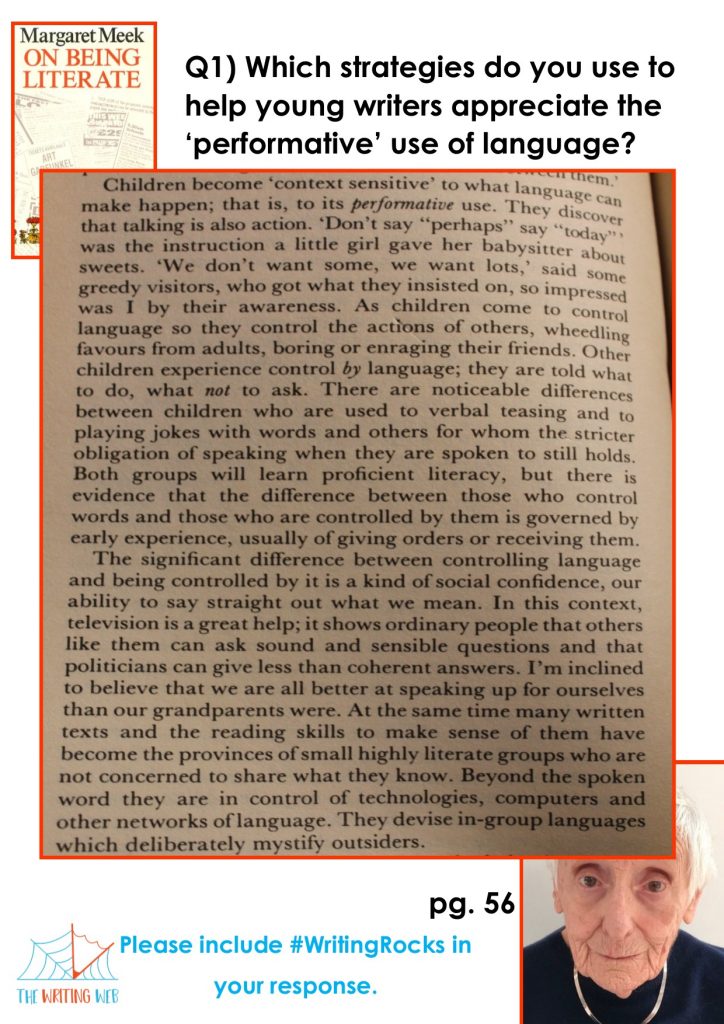
- The obvious thing to say is that children should be engaging in writing projects which result in their being a need to perform their writing at its end…!
- This is why I love the concept of personal diaries. Just a great space for them to truly write for pleasure and themselves. It’s where I fell in love with writing as a child.
- I’m just processing this but my first thoughts are about helping the children to understand they have a voice. In written and spoken word. There needs to be a trust between listener and speaker, reader and writer.
- Exactly what I thought, voice and trust!
- I had forgotten all about this book by Margaret Meek – it was so influential when I was at teacher’s training college in the 1960s and still influential when I did my MA in Education in the mid 1990s. A classic.
- A visit to a homeless shelter has prompted an urge in one pupil of mine to launch a campaign. She got up with courage in assembly and told the whole hall of her intentions despite backing out the previous week due to nerves. She is now writing a letter to send out 1/2
- To the whole school to fundraise. I caught her in the head’s office typing up her ideas this lunchtime in a letter. Is that performative?
- This is a beautiful thing.
- To answer the question though, I think daily class sharing & author’s chair is a very good strategy in getting children to appreciate the ‘performative’ aspects of writing. This way, they practice it, see it and hear it happening every day.
- I agree. Author’s chair is a wonderfully levelling experience too. Talking together as fellow writers expressing common ideas on a variety of personal ways.
- This just makes me think of that wonderful but also warning quote from educationalist John Taylor Gatto: ‘You either learn your way towards writing your own script in life, or you unwittingly become an actor in someone else’s’.
- It’s social justice.
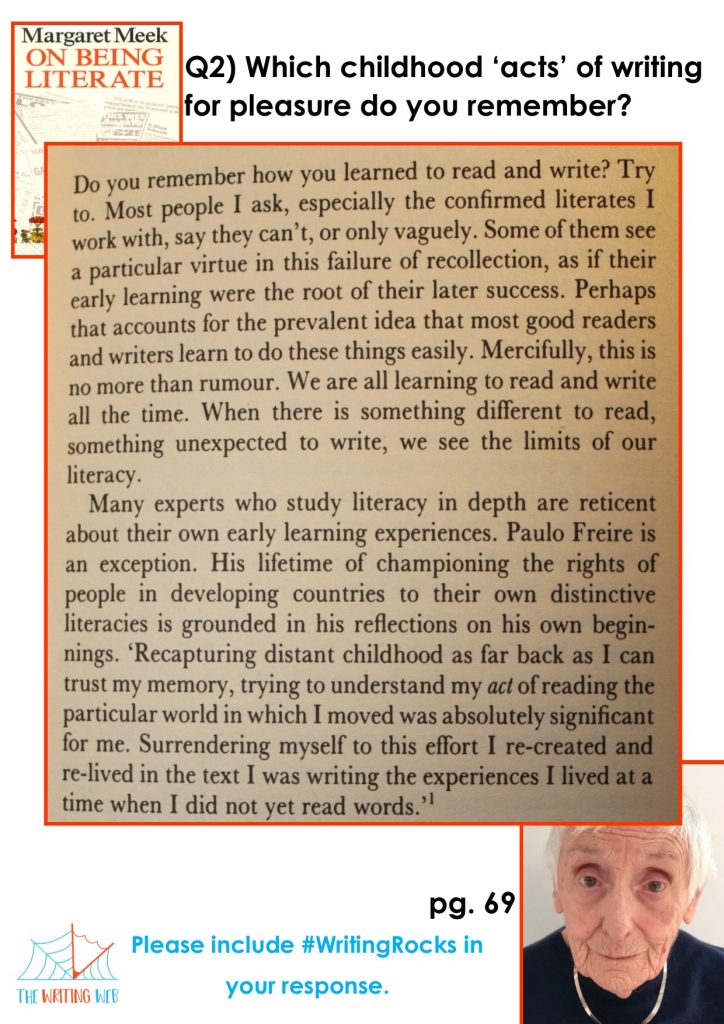
- In 2014 Paul Gardner surveyed over one hundred trainee-teachers & found that only 1.8% wrote with and for pleasure. Half the teachers surveyed stated that they never have and never do enjoy or find pleasure in writing. What can that tell us do you think?
- There’s a lot of people missing out???
- And that many teachers are over-stretched. Some Did I once read that some Scandinavian countries teachers only work 3 days a week, in others there’s 2 teachers per classroom, I wonder if their feelings toward reading & writing for pleasure differs if they have more ‘pleasure’ time?
- I was petrified to read aloud & my reading teacher made enforced it so I refused to go back to school, so my folks spoke to her & she didn’t make me read aloud anymore but she did send me postcards every time she went on holiday & I had to learn to read them, clever teacher
- I take part in a writing group of other English teachers. Starting out it highlighted all the problems and fears we often are flippant about in the classroom. #teachersaswriters made me much more conscious and sensitive to that when asking kids to write and read out in lesson
- Sounds like a great group. RE reading aloud perhaps let those who want to and not those who don’t? I think it’s a lot to do with readiness, after years of being raised with no TV but Radio 4 plays I have a great reading voice & confidence but not when I was wee at school
- I remember have diaries as a child, a process which I adored and learnt about self-regulation (also part of the reason I think I’m so critical/self-aware/analytical of behaviours!). Rewriting song lyrics and writing silly comics was fun but I can’t remember being taught…
- Oh actually! I remember in Year 4 doing a rewrite of a bit from a book about Jamaica? And using Jamaican patois in my retelling.
- I used to love ‘Mad Libs’ which was a flip over booklet of silly stories with words removed and you had to add in your own additions. I also loved writing poetry in high school but not really about anything in particular.
- It’s really sad to admit, but I truly remember no ‘acts’ of writing until I was about 14 when we studied Of Mice and Men. A fabulous, fabulous English teacher who really helped me to love English. Before that… no memories
- I don’t think honest reflection is ever sad. This experience has obviously informed the way you practice as a teacher today. Fabulous teachers are so important.
- Writing poetry, playing with words, then running around the playground holding my poem! I still do both, write and run; possibly not at the same time…
- I’m afraid I don’t have many positive memories of writing or learning to write. Phil does though. Transcription was king at my school. I was left-handed and couldn’t spell. With regard to the latter, I wish I had been taught that proof-reading existed!
- I remember being enthused by the things I loved. Writing things like a diary entry about the Tudors was my absolute jam
- All the usual suspects for me:
- pen pal (I was supposed to communicate in German. I didn’t.)
- letter writing
- postcards (I’m still cramming holiday waffle into every last millimetre)
- illicit notes
- With the exception of no1, I still love expressing myself in these ways.
- My brother and I scripted and recorded a radio show for my Grandad’s birthday. Loved it. Took it very seriously.
- That’s really special – he must have really loved that.
- We found it recently when we clearing out Grannie’s house. Hilarious. And surprisingly witty!
- Writing my own adventures/campaigns for D&D. Used to send them off to White Dwarf, never got published but still enjoyed playing them with my friends. One was based on Lord of the Rings and one was based on the Suffolk coast.
- The Daemons of Folkestone?
- If only Folkestone was in Suffolk…it was actually a Call of Cthulhu adventure set in Southwold, in the fictional home of Sigmund Freud.
- Sorry. I’m half asleep. I meant Felixstowe! Different “F”. Different county!

- Teaching personal narrative (memoir writing). – Inviting chn to use their own ‘funds of knowledge’ & ‘funds of identity’ in non-fiction writing.
- Allow children to go from simply ‘knowledge telling’ school-based knowledge to ‘knowledge transforming’ by linking what’s learnt to their own lives & outside knowledge.
- Simply invite children to write in personal response to the things they have had read to them or that they are reading themselves.
- Today with the Creative Writing club I read ‘The Mysteries of Harris Burdick’ – a truly wonderful book. Their writing started off linked to the theme and then each child’s musings became so much more about them and their own experiences.
- I thought it was a phenomena of the last 10 years ago & was shocked to find out ‘The Mysteries of Harris Burdick’ was published way back in 1984 when I started Infants 1!
- Are you familiar with this one?
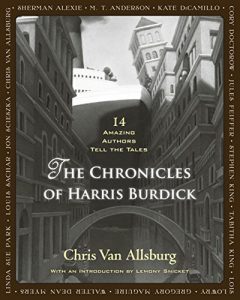
- @Jon_Scieszka‘s dark contribution might be my favourite.
- Truly a wonderful, wonderful book. I would be interested to know how many teachers know of it.
- This is interesting. I have a bit of a problem with the current obsession with vocabulary. Don’t get me wrong: I love words and want children to know and love many too. But there’s a fakery in sticking in words they don’t truly know in the belief that it makes “better” writing.
- Children need to appreciate how to use the words they know and use in the most direct way. In this way children’s voices and truly respected.
- This was one of the first frustrations shared by the teachers I was training on Monday. It’s all about fitness for purpose and having sufficient vocabulary to be able to express yourself to the best of your ability at that time.
- “Said” is good. “Murmured” “hissed” “yelled” have their place but… “Said” is good. (Read Stephen King on writing)
- Personal project books, letter writing (purposeful), poetry (children’s language and ideas). Did I say personal project books?
- I actually really loved the weekly ritual of Monday morning diary writing. It was predictable for the children and so – quite quickly – the need to think about purpose, audience etc. was removed and it became habitual.
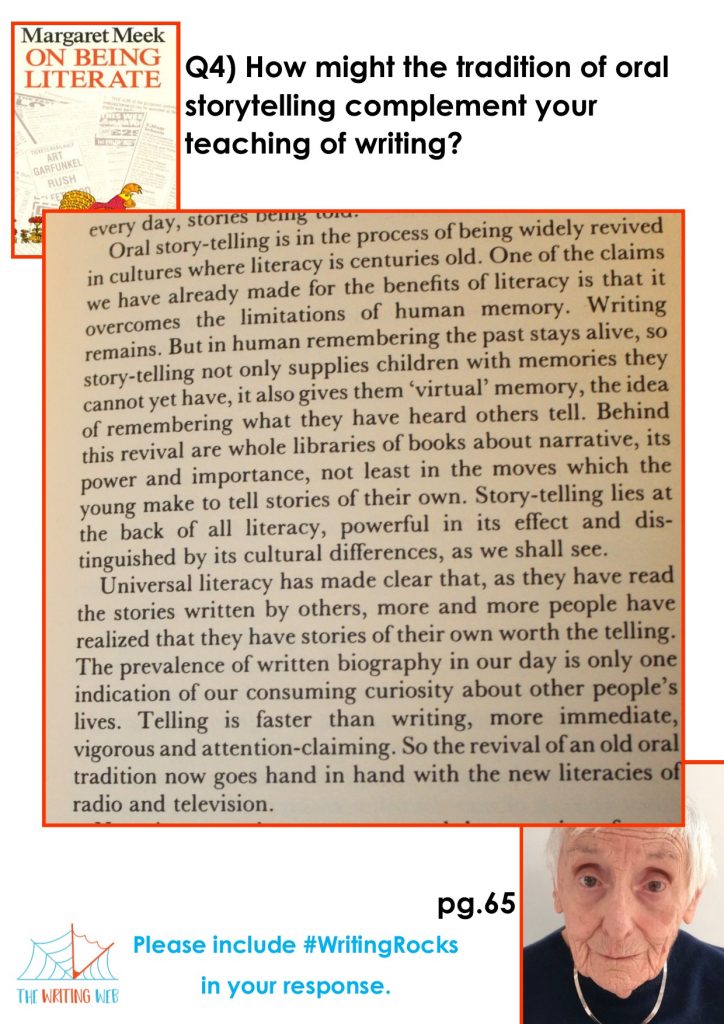
- We tell stories all the time but I don’t think these are valued enough in writing in schools: “last night at the skate park” “the boring world of shopping” “what my brother told me”. All superb titles. All superb stories. All told orally, every single day.
- Exactly! Just listen to the kids when they are eating their lunch – your writer’s block will soon go. You’ll be inundated with ideas!
- But not as “valued” as a non-chronological report on the history of volcanoes. Ahem.
- x30 copies please 😉
- Still. It’s easier to mark. That’s what counts.
- But impossible to know whether they can write independently.
- It IS possible. We know who can write independently & who can’t & which practices can support this. That’s why it annoys me when people advocate an over-scaffolded approach to the teaching of writing (OK, anything) and then act surprised when children have little agency or autonomy.
- And this is why I will not advocate “hot” and “cold” writes. Writing is writing. It doesn’t have temperature.
- Utter nonsense I’m afraid.
- @LondonLATE did a conference based around the idea that We Are Our Stories from the work of Betty Rosen. Shapers and Polishers etc are really important for thinking about the role of stories in being a teacher.
- It’s a powerful manifesto that hasn’t aged in its relevance to children’s lives but has in relation to the priorities of policy makers.
- Great question, in some cultures oral storytelling is a significant part of their life, more so than writing. I was at school with an Irish lad from a gypsy family, he could barely read or write but by eck’ could he tell some phenomenal stories & what amazing memory skills
- I teach with Talk for Writing and the children learn the text initially. We learn it so that they are able to perform it in a fun and engaging manner. Once they learn it they are able to apply it to their own writing
- Learning a story orally and the underlying pattern reduces cognitive load when it comes to independent application
- when we are learning a new subject, it is often helpful to have diagrams or illustrations to accompany the verbal information – text mapping a story is a great way to do this
- Helps children to visualise the audience for their writing and to see how the details of life make a great story – or the foundations for one. Child in my class often takes me to listen to ‘another made-up story’ from her sibling in nursery. She’s a great story-teller!
- It really does. My children’s writing today was wonderful and shows the impact of talk for writing. What is more important though is that when I say that we are writing the children whoop for joy!
- It gives a depth and an underscore to learning that nothing else does
- Great question, in some cultures oral storytelling is a significant part of their life, more so than writing. I was at school with an Irish lad from a gypsy family, he could barely read or write but by eck’ could he tell some phenomenal stories & what amazing memory skills


nice